

Most men don’t think about mobility until something stops working. By then, muscle strength and balance have been quietly declining for years. The fix doesn’t require a gym, a trainer, or getting on the floor. It requires 10 minutes and someone who knows what they’re doing.
That someone is Dr. Mary Hill, a Palm Primary Care patient and movement specialist with several decades of experience as a Pilates, yoga, and dance instructor. This routine was put together in honor of Men’s Health Month, but the movements are built for everyone who wants to feel stronger, more aligned, and more fluid in their daily life.
Why Men Need to Keep Moving (And Most Don’t)
After 40, men lose roughly 3–8% of muscle mass per decade. After 60, that rate accelerates. Falls are the leading cause of injury-related death in adults over 65, according to the CDC, and loss of core strength and lower body stability are primary drivers.
Sitting more doesn’t help. The average American spends 11 hours a day seated. Standing exercises are among the most practical ways to fight back — they’re weight-bearing, functional, and translate directly into everyday activities.
Your Guide: Dr. Mary Hill, Palm Primary Care Patient
Dr. Mary Hill is a Palm Primary Care patient and a movement specialist with decades of experience as a Pilates, yoga, and dance instructor. Her approach focuses on alignment, joint protection, and working with the body’s natural “lines” to release fascia, restore mobility, and build the kind of stability that holds up in real life.
What’s in the 10-Minute Routine
Five movement sequences. All standing. Zero equipment. A wall, a kitchen sink, or a sturdy chair is all the support you need.
Dr. Hill works through the body’s natural lines — targeting fascia, joint mobility, and core stability in a sequence you can do anywhere. Every movement can be modified if you’re working around a bad knee, stiff back, or limited range of motion.
Here’s what the routine covers:
Spinal Sequencing
Using a wall or kitchen sink for support, Dr. Hill guides you through rolling through the spine — starting from the tailbone to open the chest and look upward, then reversing by leading with the chin down to the hips. This is functional fitness for your spine: it builds posture, flexibility, and the core stability that carries you through the rest of your day.
Foot and Heel Work
Lifting the heels during spinal sequences strengthens and stretches the feet — the foundation of your balance and stability. Most men never train their feet. This is an easy fix with a compounding payoff.
Lunges for Length
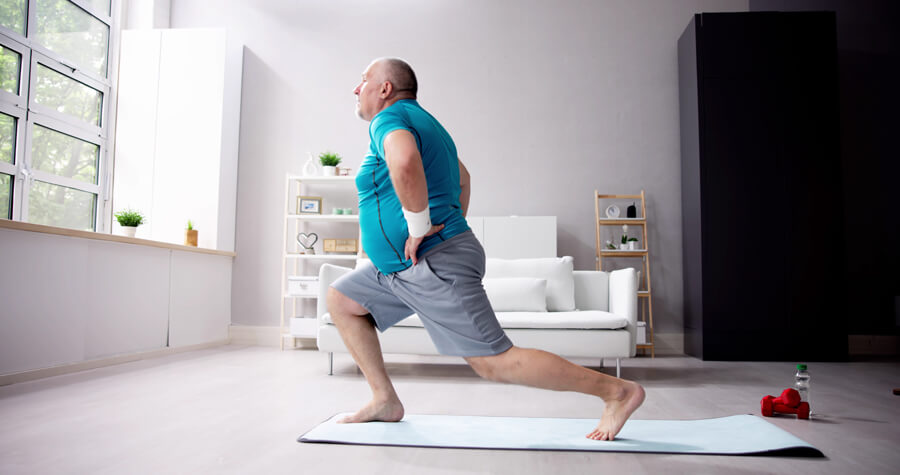
Modified lunges that elongate the back line, psoas, and quads — exactly what tightens up from hours of sitting. Done with a chair to keep stress off the knees, hips, and wrists. Accessible for most levels.
Lateral and Oblique Lines
Hip displacement and folding sequences (finger to shoulder) that target the lateral and oblique lines of the body. This is where side-body strength and flexibility live — the stuff that keeps your balance sharp and reduces fall risk.
Triangle Position
Rotating the front leg while keeping the back foot forward deepens the lateral stretch and improves hip mobility. No floor work. Just the range of motion most men don’t realize they’ve lost.
How to Build This Into Your Week
Start once a week. That’s it. Learn the movements, get comfortable with how they feel, and let your body adjust. You don’t need to go all-in on day one.
Then build. Add a session when the first one feels like nothing. Keep stacking until you’re hitting it 3 to 5 times a week — that’s when the results start showing up. Improved balance, less stiffness, more strength in the movements that matter.
Tie it to something you already do — morning coffee, lunch break, end of the workday. Ten minutes. Do it again next week. Then twice. Then more.
Before starting, check in with your Palm Primary Care provider — especially if you’re managing a chronic condition or haven’t been active in a while.
Movement Is Step One — Primary Care Is Step Two
This routine handles the movement piece. But men’s health has a longer checklist: blood pressure, blood sugar, cholesterol, weight, and screenings that don’t show up in a workout. Those show up at your annual visit.
Men’s Health Month is the right time to do both. Find a Palm Primary Care location in DFW or call (866) 840-7728.
Frequently Asked Questions
Is this routine safe if I have bad knees or back pain?
Yes, with modifications. Dr. Hill specifically addresses joint protection throughout the video — lunges can be done with a chair, wrist-sensitive movements can be swapped for fingertip support, or a sink edge. Move within a pain-free range and ease into it. Your Palm provider can help you adjust to specific conditions.
Do I need any equipment or special space?
Nothing required. A wall, a kitchen sink, or a chair for light support is all you need. The whole routine fits in a small living room.
How long until I see results?
Most men notice improved stability and reduced stiffness within 2–3 weeks of consistent practice. Fascia responds to repetition — the more regularly you do this, the more fluid and open the movement becomes.
Can my primary care doctor help me build a fitness plan?
Absolutely. Your Palm Primary Care provider can take into account your health status, any chronic conditions, and your goals to help you create a movement plan that makes sense for you. Bring it up at your next visit.
Ready to Take Care of the Whole Picture?
Palm Primary Care has nine DFW locations, same-day appointments, and providers who listen. Start with this routine — then book your visit.







Leave a Reply